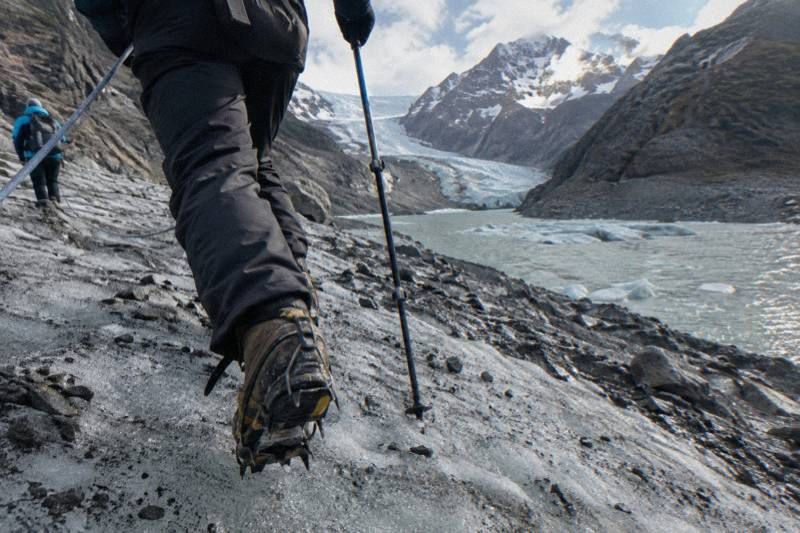
Heli Hike Photography: What To Bring To The Ice
Both operators that run the Tasman Glacier heli hike put a camera on the bring list, and both set limits on what can travel in the helicopter. Here is what the operator pages actually say about cameras, drones and the gear you carry onto the ice.
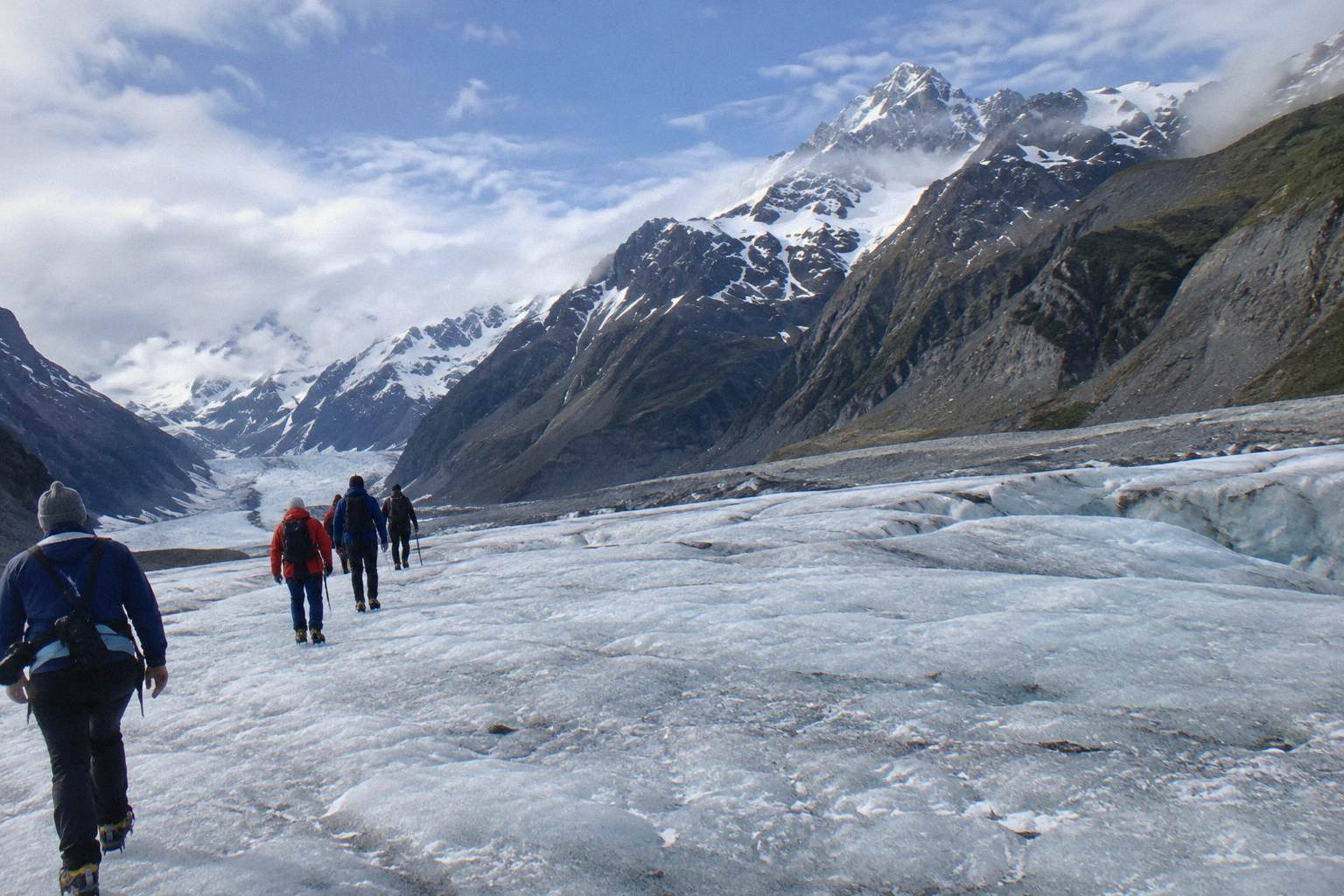
Short answer
A camera is on the official bring list for the Tasman Glacier heli hike, but The Helicopter Line asks visitors to leave behind large cameras on a strap, drones, power banks and iPads. Recreational drones are banned everywhere in the national park. Boots, crampons and most cold-weather gear are provided.
A camera is the one piece of personal equipment both operators of the Tasman Glacier heli hike explicitly tell you to bring, which is telling: the glacier is 23 kilometres long, up to three kilometres wide and covers 101 square kilometres, and almost none of it can be reached on foot. The question for a photographer is not whether to carry a camera but what kind, how to carry it, and what has to stay behind. The rules come from three places: the operator pages, the booking listings, and the Department of Conservation, which manages the park the flight departs from.
Here we pull together every camera and packing rule the operators publish, separate what is provided from what you carry, and flag the areas where no operator has published a rule at all. It draws on the Mount Cook Ski Planes heli hike page, the The Helicopter Line's Tasman Glacier Heli Hike page and Alpine Guides' trip page, plus DOC's park guidance. Where a source is silent, we say so rather than guessing.
What Camera Gear Can You Take On A Heli Hike?
You can take a camera: it is on the official bring list for both brands. Mt Cook Glacier Guiding lists "camera" alongside sunglasses and warm layers, and The Helicopter Line asks visitors to leave behind only large cameras on a strap, drones, power banks and iPads. Small cameras that fit in a daypack are not restricted by either operator, and phones are not mentioned at all.
The distinction the operators draw is about size and loose attachments, not photography itself. A compact camera, a mirrorless body with a small lens or a phone is compatible with the packing guidance on both pages. What The Helicopter Line flags is a large camera hanging from a strap, the kind that swings free while you walk, alongside loose clothing and scarves. On a trip where you wear crampons, walk with poles and possibly a harness, anything dangling is the concern.
That framing matters for how you pack. A camera that lives inside a small backpack until you want it is within the spirit of both lists. A camera slung across your body with a long lens, carried loose for the whole two hours on the ice, is the case the operator page asks you to avoid. There is no weight or model rule published anywhere, so treat "large and loose" as the line the operators have drawn. It is also worth remembering that three brands sell essentially the same day out: Mt Cook Glacier Guiding flying with Mount Cook Ski Planes and Helicopters, The Helicopter Line with Alpine Guides, and Southern Alps Guiding as a third option sold direct. Their gear lists overlap heavily but their fine print differs, so always read the list attached to the trip you actually booked.
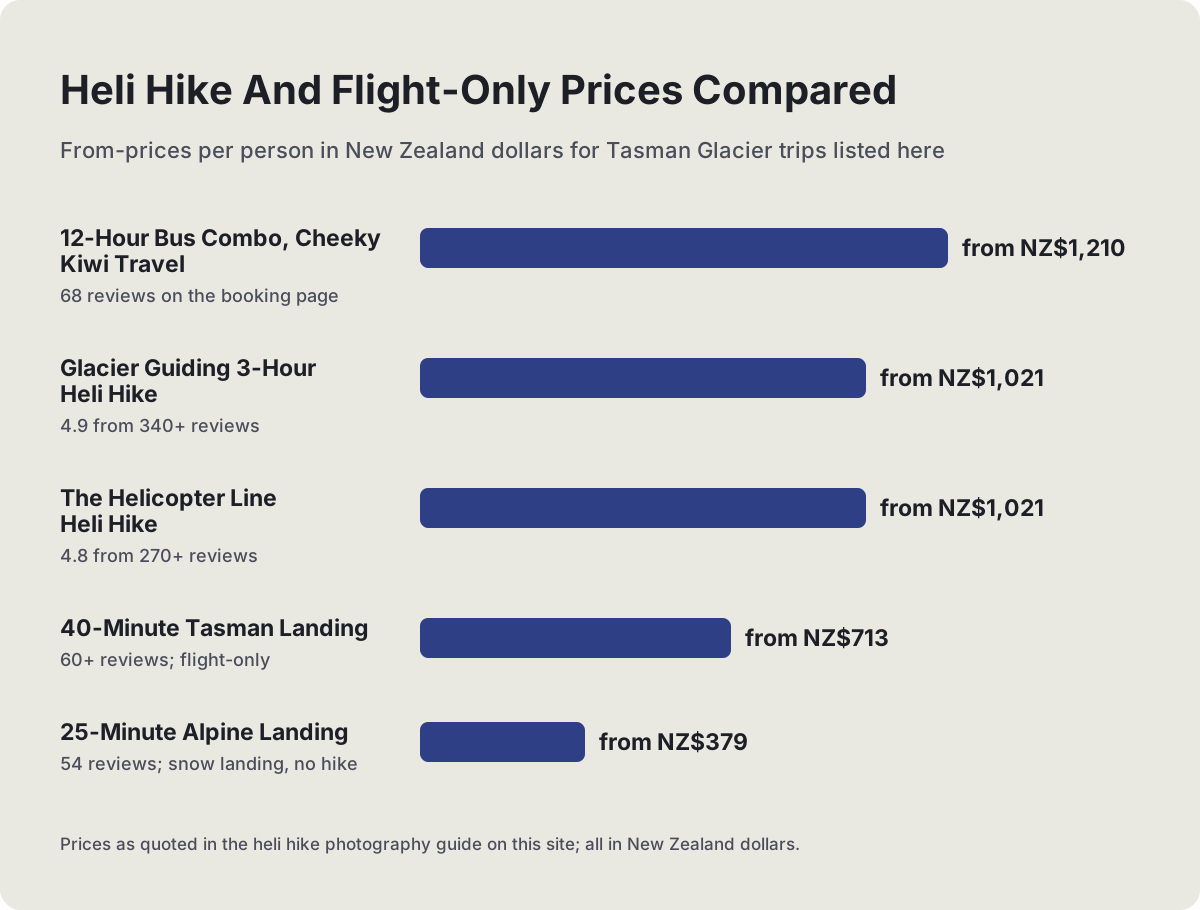
- Glacier Guiding 3-Hour Heli HikeNZ$1,021
- Helicopter Line 3-Hour Heli HikeNZ$1,021
- 12-Hour Bus Combo, Heli HikeNZ$1,210
- 7-Hour Fly-In Heli HikeNZ$2,149
If you want to see the trips these rules apply to, the core heli hikes from Mount Cook Airport sit alongside a snow-landing flight that covers similar country without the hike:
The featured option, the Glacier Guiding 3-Hour Heli Hike, is rated 4.9 from 340+ reviews and costs from NZ$1,021 per person. Note the currency point once here: all prices are New Zealand dollars. The Helicopter Line's version of the same day carries a 4.8 rating from 270+ reviews at the same from-price, and the 40-Minute Tasman Landing is a flight-only alternative at from NZ$713 per person, with 60+ reviews on its booking page.
What Do The Operator Pages Actually Say About Cameras?
The Helicopter Line's leave-behind list names large cameras on a strap, drones, power banks, iPads, bags, jeans, loose clothing and scarves. Mt Cook Glacier Guiding's bring list includes a camera, a daypack, drinks and snacks. DOC bans recreational drones everywhere in the park, and no operator page mentions phones or action cameras at all.
That is the complete published record. It is short, and it is worth reading precisely, because most photography advice about this trip that circulates online goes well beyond what any operator has actually said. The table below is the full camera-relevant rule set by source, with nothing added.
| Source | What it says about cameras and devices | Where it applies |
|---|---|---|
| Mt Cook Glacier Guiding | "Camera" on the bring list, with sunglasses, sun protection, daypack, drink and snacks, warm hat and gloves | The Adventurer, about 3 hours, up to 2 hours on the ice |
| The Helicopter Line | Leave behind large cameras on a strap, drones, power banks, iPads, bags, jeans, loose clothing and scarves | Tasman Glacier Heli Hike, check-in 15 minutes before departure |
| Alpine Guides | Loans of socks, gloves, hats, backpacks and jackets if needed; no camera rule published | The same heli hike sold under the Alpine Guides brand |
| DOC, Aoraki / Mount Cook National Park | Recreational drones are not allowed anywhere in the park; commercial drone use needs a permit | The whole park, glacier included |
Two implications follow. First, the drone ban is not an operator preference, it is park-wide: even if an operator were relaxed about it, the DOC rule covers the landing site and everything around it. Second, the silence on phones and action cameras is real silence. Neither operator page addresses them, so if you plan to shoot on a GoPro-style camera or a phone the whole time, ask the operator at booking. Claiming either is allowed or banned would go beyond the published rules.
For context on the wider decision, our guide to what to wear on a glacier heli hike covers the clothing side of the same lists. The airport itself sits on SH80 before the village, and the drive in is 3.5 hours from Queenstown or 4.5 hours from Christchurch per DOC, which shapes how much spare camera gear is realistic to have on hand on the morning. Twizel, an hour away, and Tekapo, an hour and a half, are the nearest supermarket towns if you need batteries, snacks or last-minute layers the day before.
What Should You Bring Versus Leave Behind?
Bring, per the operator lists: a camera, a small backpack or daypack, sunglasses, sun protection and lip balm, a warm hat and gloves, three to four warm upper layers, warm trousers that are not jeans, and a drink and snacks. Leave behind: large cameras on a strap, drones, power banks, iPads, bags, jeans, loose clothing and scarves.
The two lists are close to mirror images, and they exist because the environment is practical rather than precious. You will be fitted with leather boots, crampons, and possibly a harness, and you will spend up to two hours on the ice. Loose items catch on gear, jeans stay wet and cold, and a strap-slung camera moves exactly where you do not want it when you are using walking poles.
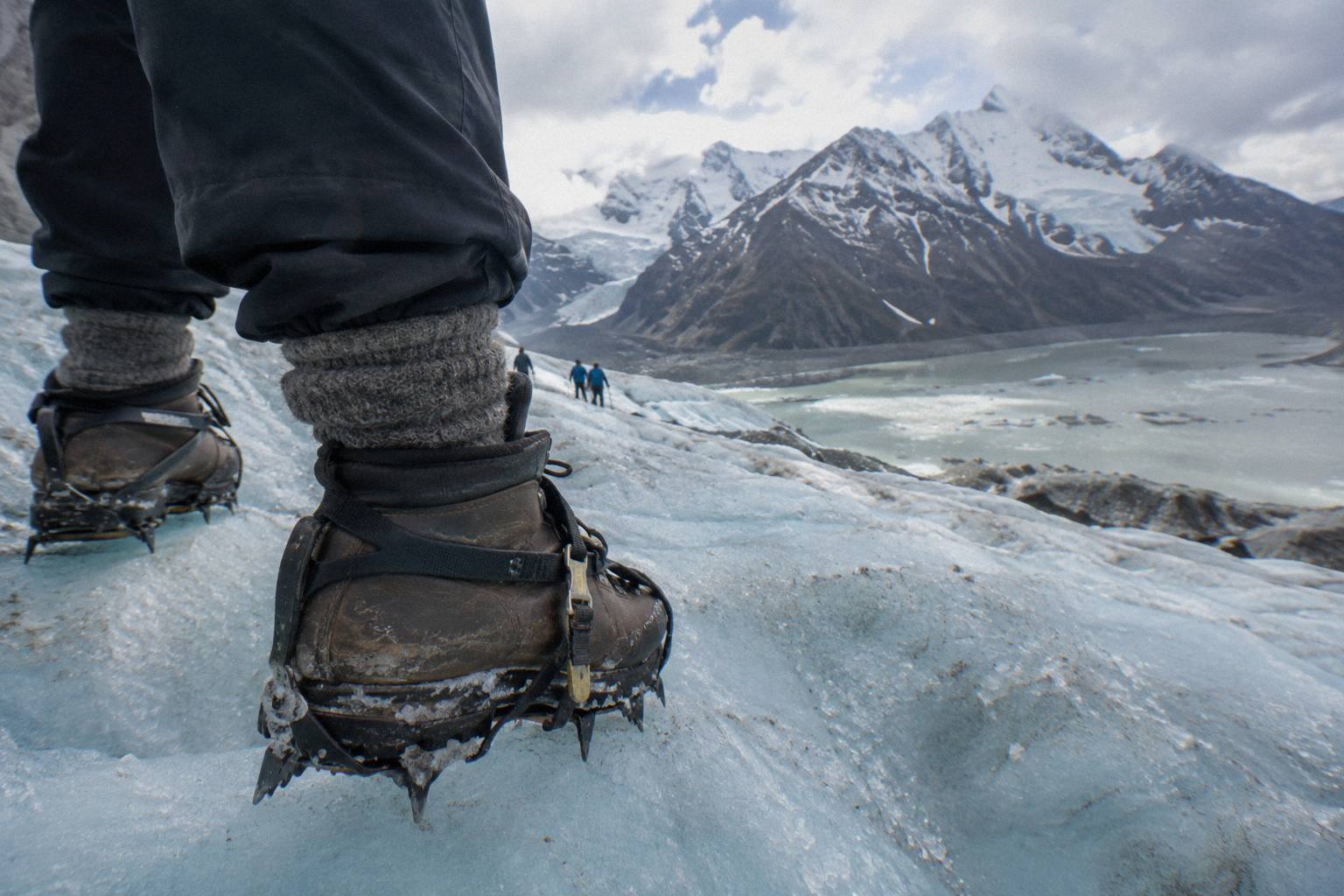
The full comparison, drawn only from the operator bring and leave-behind lists:
| Bring | Why | Leave behind | Why |
|---|---|---|---|
| Camera | On the Mt Cook Glacier Guiding bring list | Large cameras on a strap | The Helicopter Line leave-behind list |
| Daypack or small backpack | Named by both operators | Bags | The Helicopter Line leave-behind list |
| Sunglasses, sun block, lip balm | Both operators | Drones | Operator list and the DOC park-wide ban |
| Warm hat and gloves | Both operators | Power banks, iPads | The Helicopter Line leave-behind list |
| 3 to 4 warm upper layers | Mt Cook Glacier Guiding | Jeans, shorts, skirts | Both operators |
| Warm trousers | Mt Cook Glacier Guiding | Loose clothing and scarves | The Helicopter Line leave-behind list |
| Drink and snacks | Mt Cook Glacier Guiding | Selfie sticks, drones | Mount Cook Ski Planes trip rules |
For photographers, the sharpest constraint in that table is the power bank. If your camera strategy depends on keeping a phone or tablet charged through a long day in the mountains, the leave-behind list closes that route on The Helicopter Line's trip. Spare camera batteries carried in the daypack are not restricted by any published rule, which makes them the straightforward answer for a full day around the village. Our guide on planning a Mount Cook day around a heli hike is useful here, since the village has only limited cafe and food outlets and the nearest supermarkets are an hour away in Twizel or an hour and a half in Tekapo.
How Do You Carry A Camera While Wearing Crampons And A Harness?
Carry the camera inside the daypack, not on a strap, and take it out at stops. Both operators provide the technical layer, boots, crampons or snowshoes, poles, jacket and over-trousers, so your own packing job is reduced to warm layers and small personal items that zip away. A camera that stays packed until the group pauses is within every published rule.
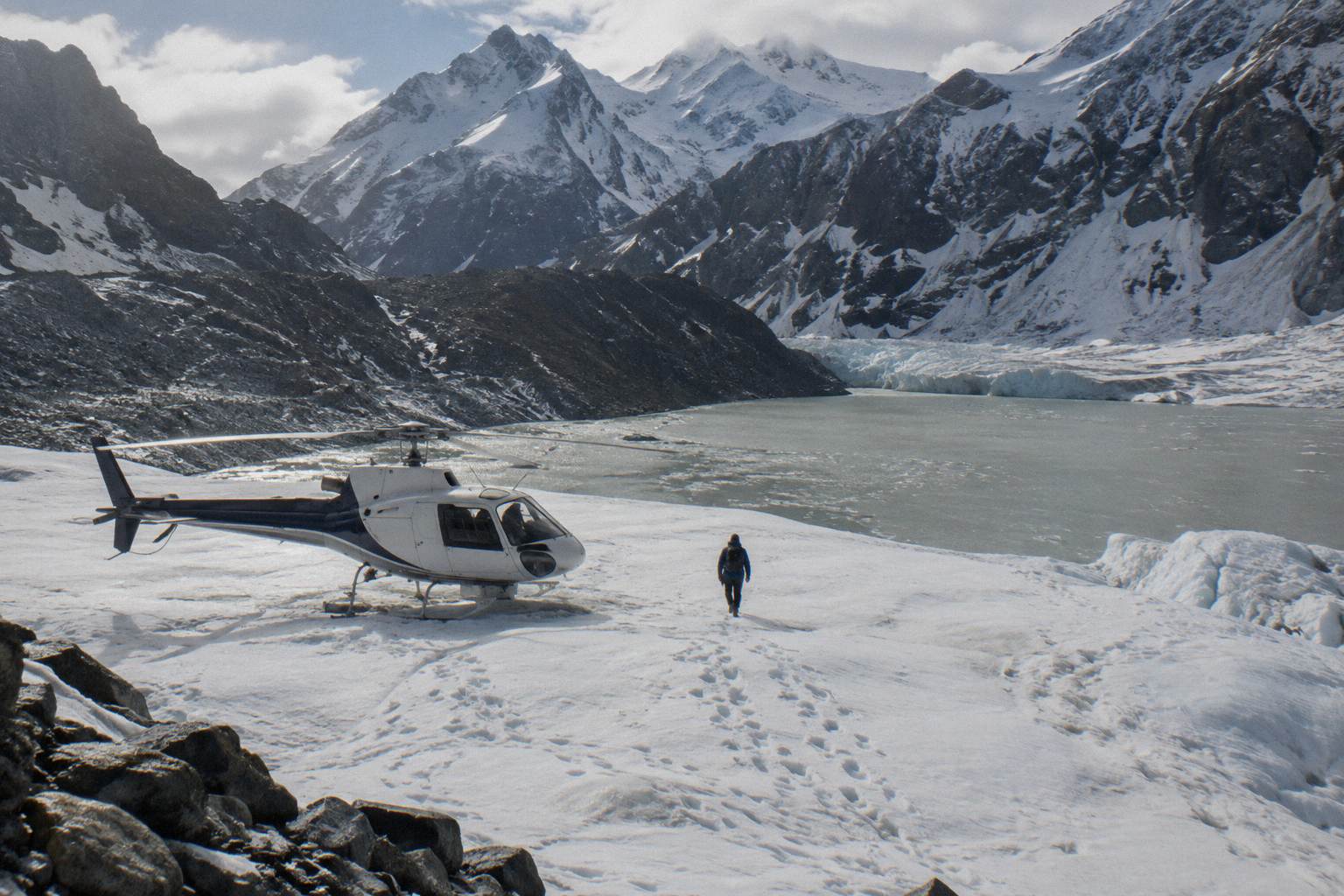
The physical setup explains the rules. Mt Cook Glacier Guiding's kit includes leather boots and woollen socks, crampons in summer and crampons or snowshoes in winter, adjustable walking poles, a harness if required, and a waterproof jacket and over-trousers. The Helicopter Line provides glacier boots, crampons or snowshoes, walking poles, woollen socks and a waterproof jacket if required. Gear is fitted by the guide before the flight. Once you are wearing that, your hands are holding poles, and everything else needs a home.
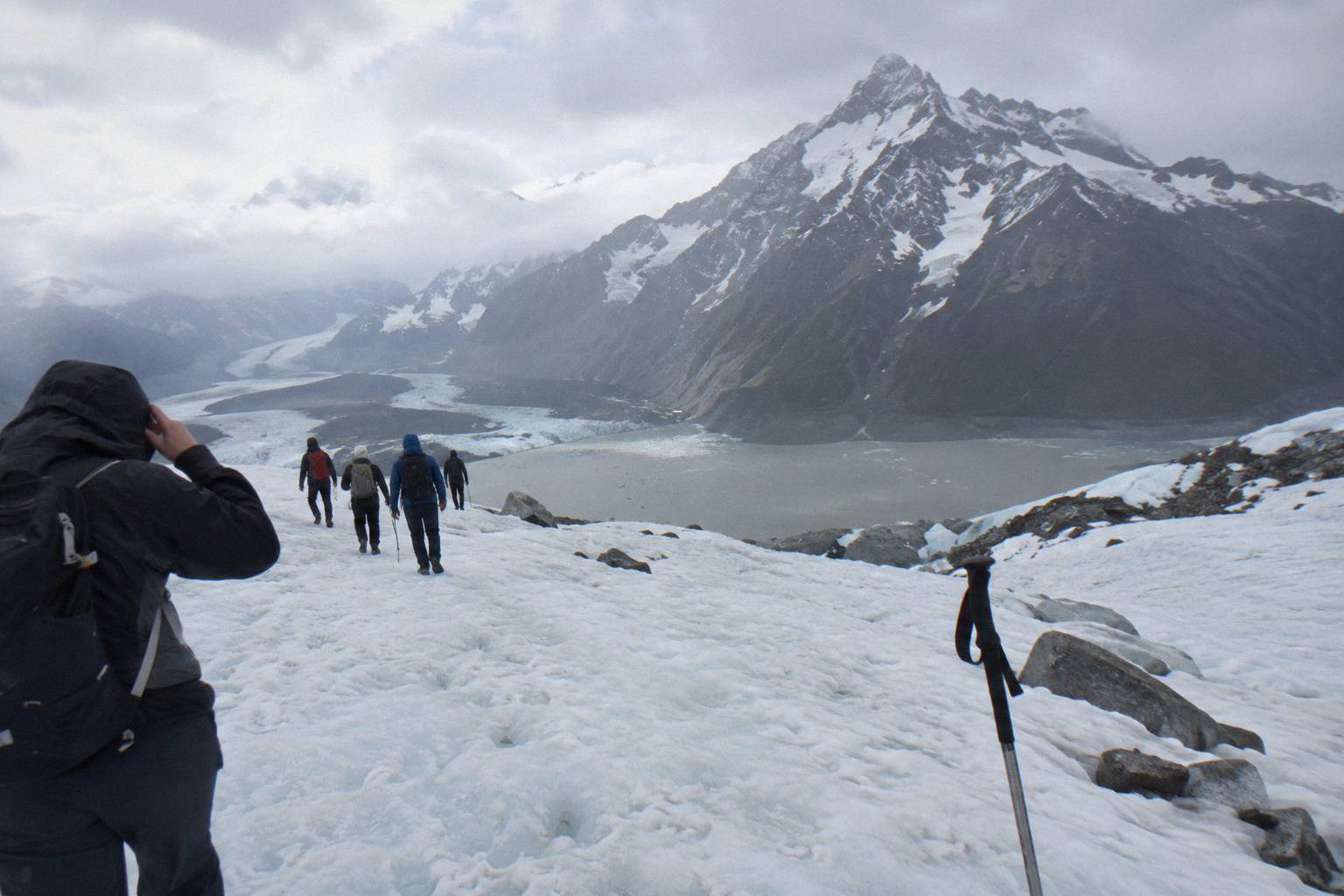
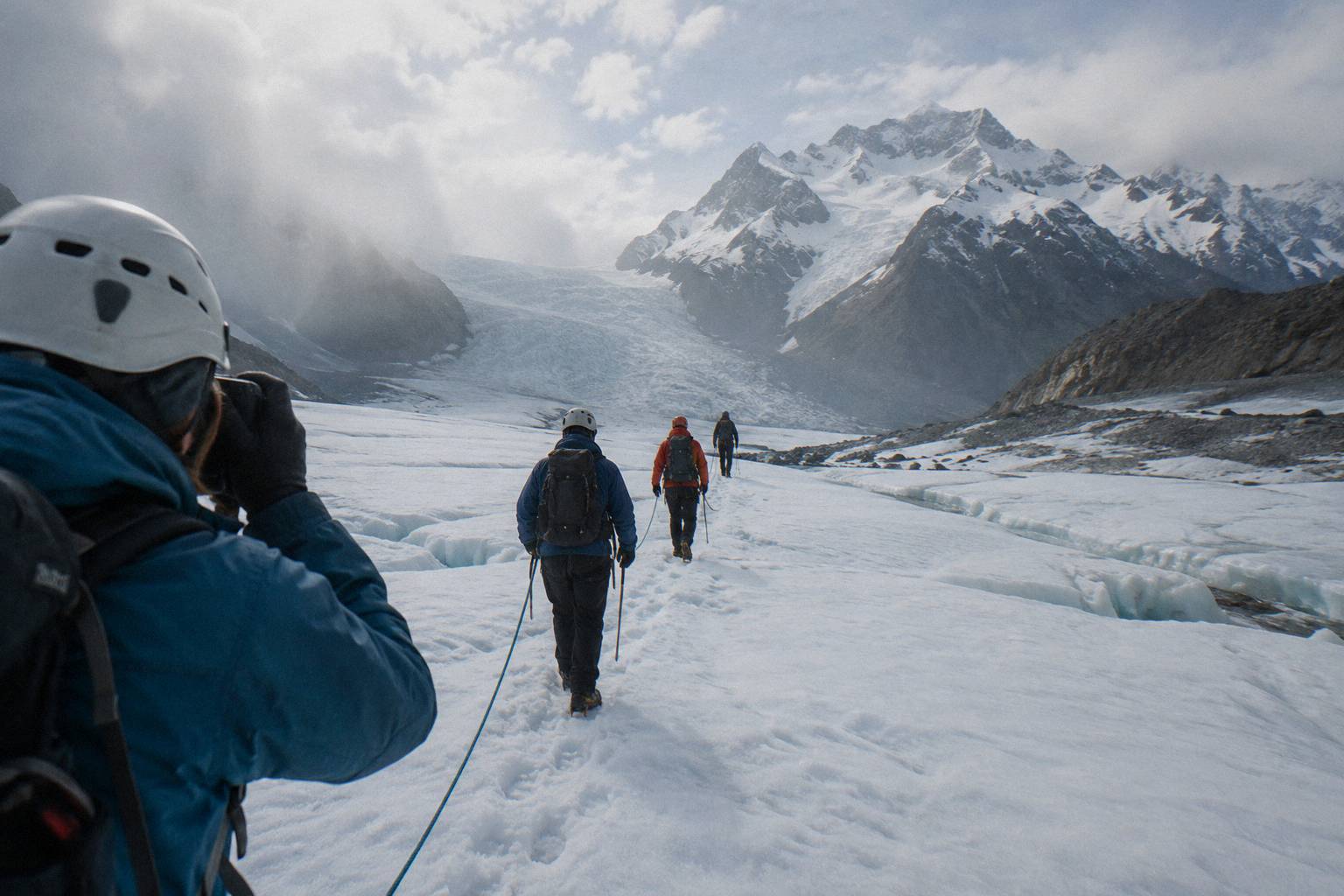
A practical packing pattern that fits the rules: camera body and one lens in the daypack, spare battery and a small cloth in the same bag, nothing attached to the outside. When the group stops, the pack comes off and the camera comes out. Guides run small groups, up to 11 people with Mt Cook Glacier Guiding and up to 20 with The Helicopter Line, and an Alpine Guides guide ratio of 1:12, so there are natural pauses on a two-hour walk. Nothing in any operator list limits how often you stop to shoot within the group's pace.
The gear-fitting detail is worth planning around. Mt Cook Glacier Guiding asks that you arrive on time because fly times are strict, and The Helicopter Line asks you to check in upstairs at Mount Cook Airport 15 minutes before departure and to call 24 hours ahead for a weather check. Camera packing that you can do at the car, rather than in the check-in queue, keeps the morning simple. If you are weighing where to sleep the night before, our piece on where to stay for an early heli hike goes through the options.
Can You Fly A Drone Or Use A GoPro On The Heli Hike?
No drone, anywhere: DOC bans recreational drones across the entire national park, and commercial use needs a permit, so the question is closed before the operator lists even come into it. Neither operator addresses action cameras and phones, so ask at booking rather than assume either way.
The drone position deserves emphasis because it is the one camera question with an unambiguous answer. Drones appear on The Helicopter Line's leave-behind list, on the Mount Cook Ski Planes trip rules for its other products, and in DOC's park guidance, which states recreational drones are not allowed anywhere in Aoraki / Mount Cook National Park. A drone left at the accommodation is not a workaround, it is the rule.
Action cameras are genuinely undecided territory. No operator page we were given mentions GoPro-style cameras, helmets mounts, chest harnesses or phones by name. The generic advice to "ask the operator at booking" is not a hedge, it is the only accurate position available, and it costs nothing to ask when you reconfirm the weather call 24 hours out. Our blog post on whether you can take a drone or GoPro on the heli hike works through the same evidence in more detail.
For anyone whose photography plans are the reason to book, there is a second decision worth making early. The flight-only alternatives trade the two hours on the ice for more time in the air at a lower price, and the 25-Minute Alpine Landing from Mount Cook Airport, from NZ$379 per person with 54 reviews on its booking page, keeps a window seat and a snow landing in play without the hike. Check-in for that flight closes 30 minutes before departure, and a minimum of four people per flight applies before it operates.
The snow-landing flights are a different product, not a shortcut version of the hike, and our comparison of the heli hike versus a glacier snow landing lays out the trade-offs for photographers deciding between time on the ice and time in the air.
What Gear Do The Operators Provide, And What Does It Cost To Add?
Everything technical is included in the ticket price on both trips: boots, socks, crampons or snowshoes, poles and waterproofs, with a harness if required on the Mt Cook Glacier Guiding trip. Nothing on either bring list is available to rent separately, and no published price exists for any add-on, because there is no add-on list. If you own warm layers and a camera, your packing is done.
The provided kit differs only in fine print between brands. Alpine Guides also loans hats, gloves, socks, backpacks and jackets if needed, which means a traveller who arrives underdressed has a fallback on that brand. That loan list is the only place an operator offers anything beyond the standard kit, and it is worth knowing if your daypack space is tight after camera gear.
| Item | Mt Cook Glacier Guiding | The Helicopter Line / Alpine Guides |
|---|---|---|
| Leather or glacier boots and socks | Provided | Provided |
| Crampons, or snowshoes in winter | Provided | Provided |
| Walking poles | Provided | Provided |
| Waterproof jacket and over-trousers | Provided | Jacket if required |
| Harness | If required | Not listed |
| Hats, gloves, backpack loan | Not listed | Alpine Guides loans if needed |
| Small group size | Up to 11 | Up to 20, guide ratio 1:12 |
| Minimum age | 9, under-18s need guardian consent | 10, account holder 18 or over |
The price floor for the two core hikes is the same: from NZ$1,021 per person for the Glacier Guiding trip and from NZ$1,021 per person for The Helicopter Line's, with the longer Queenstown packages above them. The 12-Hour Bus Combo from Cheeky Kiwi Travel, from NZ$1,210 per person with 68 reviews on the booking page, includes the same glacier equipment list plus boots, gaiters and snacks on the bus, but it lists a strong fitness requirement and a large amount of hiking, which matters if you are carrying a full camera kit for twelve hours. It also notes that passengers 116 kg and over fly only depending on other passengers' weights on the day, a rule specific to that trip.
For photographers coming from Queenstown who want a shorter day, the 7-Hour Fly-In Heli Hike by True South Flights, from NZ$2,149 per person, rated 4.9 from 80+ reviews, includes a guaranteed window seat on the fixed-wing leg and a guide with all glacier safety equipment, and asks you to bring your own lunch because time at Mount Cook is limited. Its 150 kg per-passenger weight rule and central-Queenstown pickup 50 minutes before the 8:00 am departure are both trip-specific. That guaranteed window seat is a genuine consideration for anyone whose priority is photographs from the air rather than from the ice, and no other trip covered here offers the same guarantee.
How Does The Weather Question Change A Photography Plan?
Every operator states the landing and the time on the ice are weather permitting, and a weather cancellation gets you an alternative date or a full refund on the core trips. For a photographer, that means packing for a decision that can shift to the last minute, and The Helicopter Line's 24-hour weather-call step is the natural moment to confirm any camera questions too.
The published mechanics are consistent across the brands. The Helicopter Line asks you to call 24 hours before departure for a weather check and to reconfirm, and its cancellation terms give a full refund or credit with 24 hours notice, with operator weather cancellations also fully refunded or credited. Mt Cook Glacier Guiding's booking page offers an alternative date or a full refund after a weather cancellation, with free cancellation up to 24 hours before start. The booking pages for the Queenstown packages carry the same 24-hour free-cancellation terms. What can be said is structural: up to 2 hours on the ice, two scenic flights, and a landing around 1,200 metres above sea level on the Tasman Glacier per Alpine Guides, with the return flight passing close to the 1,000-metre Hochstetter Icefall. The shape of the day is fixed; the pictures depend on the day you get. Our guide to heli hike weather and cancellations works through the full decision tree, including what happens when a flight is called off late.
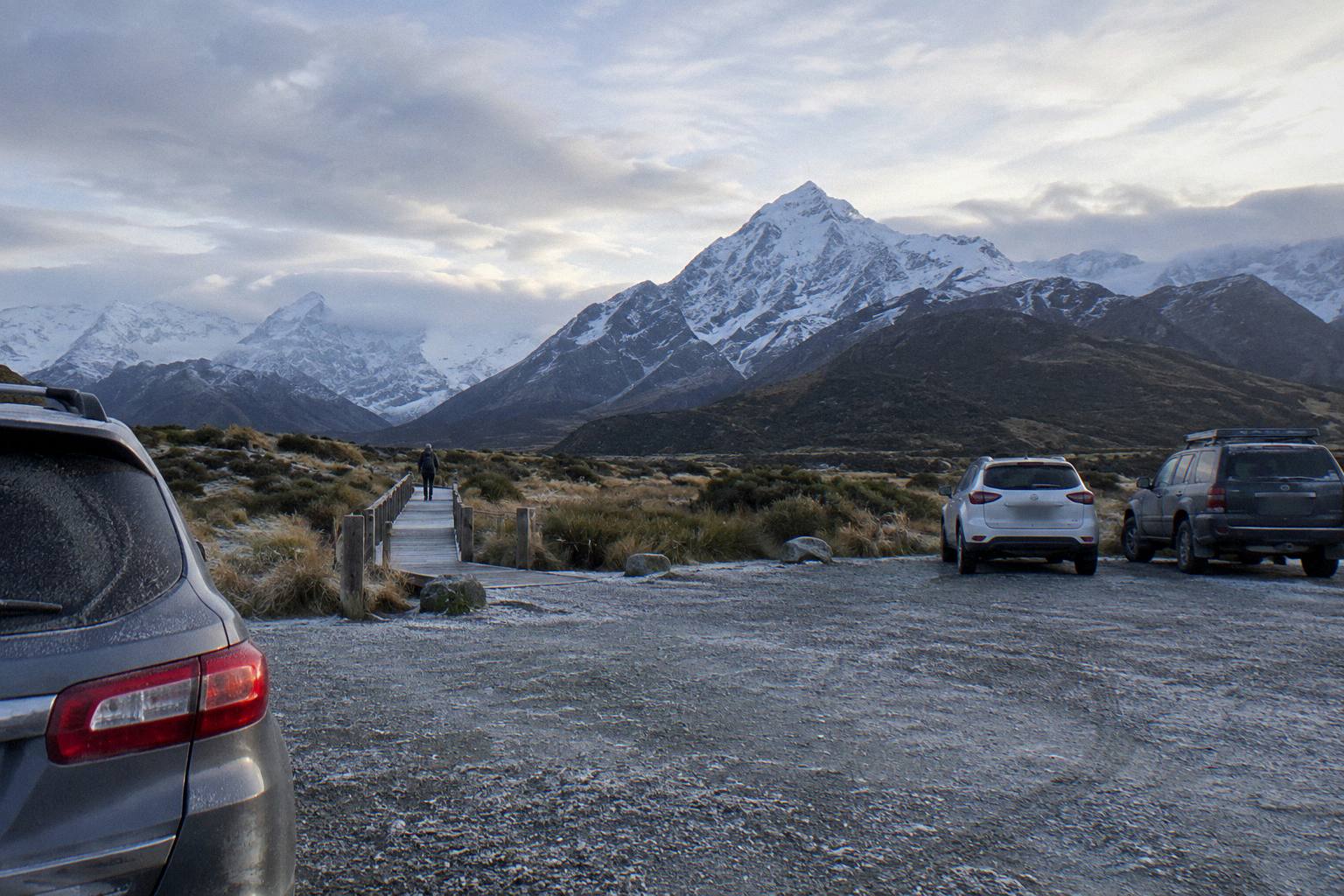
One last practical note from DOC that affects the photography day as a whole: White Horse Hill car park, the trailhead area near the village, has limited spaces from November to March between 10 am and 4 pm, parking at DOC car parks is paid with only a short free window, and winter access can be limited by snow from June to September. If your heli hike morning also involves a dawn walk for photos before check-in, the parking clock matters. The park also carries a permanent fire ban, no dogs are allowed, and avalanches can occur in any season, so the pre-dawn roadside photo stop should be a careful one.
Common Questions About Heli Hike Photography
Can You Take A Camera On A Glacier Heli Hike?
Yes. A camera appears on the official bring list for the Mt Cook Glacier Guiding trip, and The Helicopter Line restricts only large cameras on a strap, not cameras generally. Carry it in the daypack rather than loose on a strap.
Can You Take A Drone Or GoPro On The Heli Hike?
No drone, under any circumstances: recreational drones are banned everywhere in Aoraki / Mount Cook National Park by DOC, and commercial use needs a permit. Action cameras and phones are not addressed in any operator rule we were given, so ask the operator at booking before assuming either way.
Are Power Banks Allowed On The Heli Hike?
Power banks appear on The Helicopter Line's leave-behind list, so leave them behind on that trip. No other operator rule we were given mentions them. Spare camera batteries in your daypack are not restricted by any published rule.
Do You Need Your Own Boots And Crampons?
No. Both operators provide leather or glacier boots, woollen socks, and crampons, or snowshoes in winter, plus walking poles and waterproofs. The gear is fitted by the guide before departure. You bring only warm layers, sun protection, a daypack, snacks and your camera.
What Should You Leave Behind On The Heli Hike?
The Helicopter Line's list names bags, jeans, drones, power banks, iPads, loose clothing and scarves, and large cameras on a strap. Both operators rule out shorts and skirts. If it dangles, holds a charge beyond a camera battery, or stays wet, it stays behind.
How Much Time On The Ice Do You Get For Photos?
Up to 2 hours on the glacier, weather permitting, on both core trips, inside a total experience of about 3 hours including flights and check-in. Mt Cook Glacier Guiding describes the same figure as up to 2 hours on the glacier. The landing itself is around 1,200 metres above sea level per Alpine Guides.